Views: 0 Author: Site Editor Publish Time: 2026-10-23 Origin: Site
Choosing the right hydraulic hose manufacturer is important for OEM equipment performance, safety, and production planning. Hydraulic hoses must match the equipment's pressure, temperature, fluid compatibility, and installation requirements. A hose that fails to meet these requirements can cause leakage, downtime, and additional maintenance.
For OEMs, supplier selection involves more than comparing prices. Buyers should evaluate product specifications, quality control, testing capabilities, customization, production capacity, and delivery reliability. This guide explains the key factors to check before choosing a hydraulic hose manufacturer.
Table of Contents
A reliable supplier should provide clear technical specifications and explain how products are inspected. Before approving a manufacturer, confirm that its quality procedures match your equipment requirements.
Key items to review include:
Product specifications: Verify inner diameter, outer diameter, working pressure, temperature range, reinforcement, and fluid compatibility.
Incoming material inspection: Ask how the supplier checks raw materials and verifies that they meet purchasing requirements.
In-process inspection: Confirm which production stages are monitored and how nonconforming products are handled.
Final inspection and testing: Ask which checks apply to the selected hose model and whether reports can be provided.
Batch traceability: Check whether production records can identify the relevant materials, production batches, and inspection results.
Do not treat quality management certifications and product standards as interchangeable. ISO 9001 relates to quality management systems, while standards such as SAE J517 and EN 853 cover requirements for particular hydraulic hose types.
Ask the manufacturer which standards apply to your selected product and request relevant documentation. Requirements may differ by hose construction, application, and destination market. Environmental regulations such as REACH or RoHS should also be checked for applicability rather than assumed to be universal hydraulic hose certifications.
For an initial supplier review, see GSD Rubber's company profile and technical support page.
Hydraulic hoses typically combine an inner tube, reinforcement, and an outer cover. The right construction depends on the operating pressure, fluid, temperature, movement, and environmental exposure.
Ask the manufacturer to identify the materials used in the specific hose model. The inner tube must be compatible with the hydraulic fluid. The reinforcement must support the required pressure, while the outer cover should suit the expected exposure to abrasion, weather, heat, or other environmental factors.
Do not assume that all hydraulic hoses use the same rubber compound or reinforcement. Some models use textile reinforcement, others use steel wire, and thermoplastic hoses use different material structures.
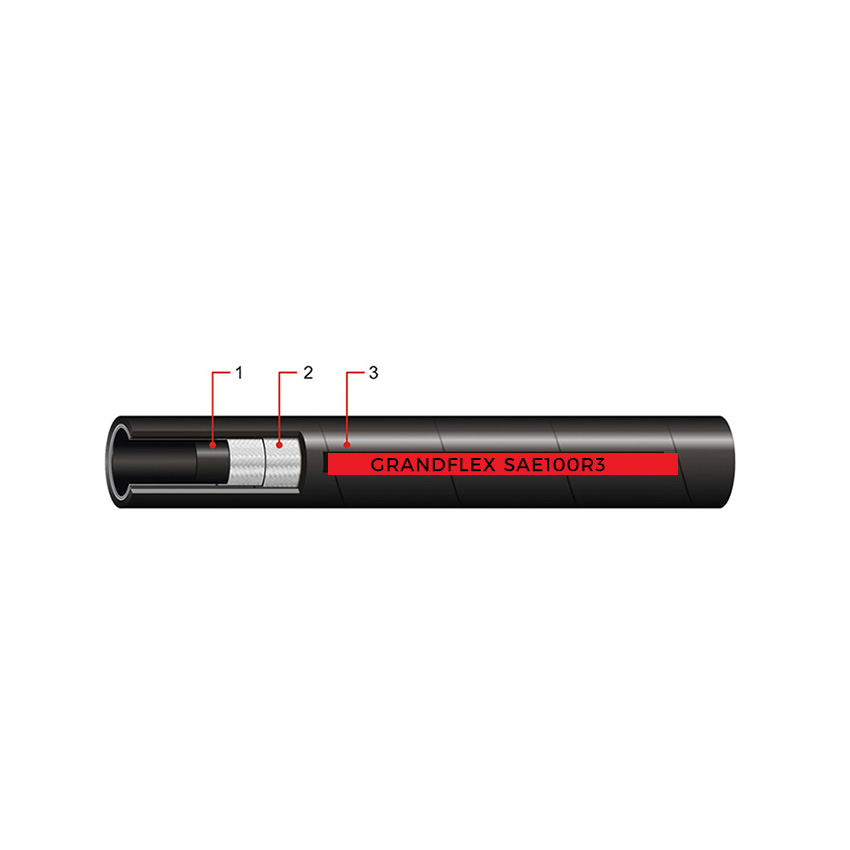
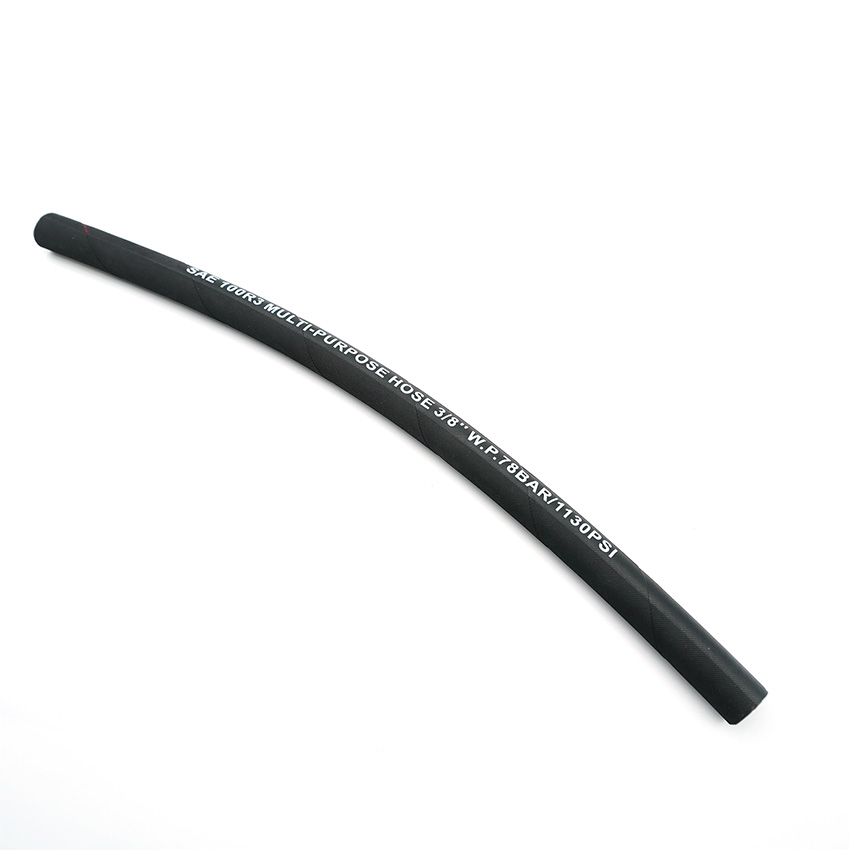
For example, GSD Rubber's SAE 100R3 hydraulic hose lists an oil-resistant synthetic rubber inner tube, two braided high-tensile polyester fiber reinforcement layers, and a weather- and oil-resistant synthetic rubber cover. These details illustrate why buyers should check the specification for each model rather than generalize across an entire product range.
Testing should be appropriate for the hose design and the requirements of the intended application. Depending on the product and applicable specifications, checks may include:
Dimensional and visual inspection.
Pressure or leakage testing.
Burst pressure testing during qualification or as required by the inspection plan.
Impulse or cyclic pressure testing where applicable.
Temperature, fluid compatibility, or cover-resistance evaluations when required.
Ask which tests are performed on the selected product, how often they are conducted, and whether the supplier can provide relevant test reports. Do not assume that every test is performed on every finished hose or every production batch.
Experience is most useful when it relates to your equipment and application. A manufacturer familiar with agricultural machinery may understand different requirements from one supplying mining or industrial equipment. Buyers should check the supplier's relevant product experience rather than relying only on the number of years in business.
Consider asking:
Which hydraulic hose types does the manufacturer produce?
Has it supplied hoses for equipment with similar operating conditions?
Can it explain material, pressure, temperature, and fitting requirements?
Does it provide technical assistance during sample approval and product changes?
Can it share relevant references or documented examples, where available?
Technical support is particularly important when the OEM is developing a new model or changing its hydraulic system. Early discussions can help identify specification gaps before they affect production.
Learn more about GSD Rubber's manufacturing background and its hydraulic hose product range.
OEM equipment may require hoses with specific dimensions, reinforcement structures, materials, or end connections. Before selecting a supplier, confirm whether it can meet the technical requirements of your project.
Discuss the following details:
Required hose type and applicable standard.
Inner and outer diameter.
Working pressure and operating temperature.
Hydraulic fluid and material compatibility.
Hose length, fitting type, and connection orientation.
Bend radius, routing space, and expected movement.
Required labels, packaging, and product identification.
A broad product range can simplify sourcing when an OEM uses several hose types. However, product variety alone does not prove that a supplier can meet every requirement. Confirm the specifications, samples, and approval process for each model.
An OEM supplier must meet both technical requirements and production schedules. Ask whether the manufacturer can support your expected order volume, delivery frequency, and forecast changes.
Important questions include:
What are the lead times for standard products and customized orders?
Can the supplier support sample orders before mass production?
How does it manage production planning and raw material availability?
What happens if an order quantity or delivery date changes?
How are production delays and quality issues communicated?
Production capacity should be assessed against your actual order profile. A large factory is not automatically the best choice for every project, just as a smaller supplier is not automatically unsuitable. Confirm capacity, lead times, and quality consistency using information relevant to your order.
The lowest unit price does not always represent the lowest overall purchasing cost. OEM buyers should consider product suitability, inspection requirements, delivery, and the potential impact of failures or delays.
Compare suppliers using the same technical specification and order conditions. Review:
Unit price and minimum order quantity.
Sample costs and approval requirements.
Quality documentation and traceability.
Packaging, shipping terms, and lead time.
Warranty terms and complaint handling.
Availability of technical support and replacement products.
Ask each supplier to clarify exclusions and additional costs before placing an order. A consistent comparison makes it easier to evaluate value without assuming that price alone predicts product quality.
Understanding the main production stages can help OEM buyers ask more useful questions about quality control.
Typical rubber hydraulic hose manufacturing may include:
Compound preparation: Rubber materials and additives are prepared according to the formulation.
Inner tube extrusion: The compound is formed into the required tube dimensions.
Reinforcement application: Textile or steel wire reinforcement is applied according to the hose design.
Outer cover application: A protective cover is added to the hose structure.
Vulcanization or curing: The rubber is cured using the process specified for the product.
Finishing and inspection: The hose is finished, checked against product requirements, and tested according to the applicable inspection plan.
The exact process varies by hose construction and material. Thermoplastic hoses, for example, do not follow every step used for rubber hoses.
Ask the manufacturer which production stages apply to your selected hose, how critical dimensions are controlled, and what inspection records are available.
For a more detailed overview, read GSD Rubber's hydraulic hose manufacturing process article.
Choosing a hydraulic hose manufacturer for OEM equipment requires a structured review of product specifications, quality control, materials, testing, customization, production capacity, and delivery reliability.
Start with the technical requirements of your equipment, then ask potential suppliers for product datasheets, applicable standards, relevant test records, and sample approval procedures. Compare quotations using the same specifications and commercial conditions.
To explore available products, visit the GSD Rubber hydraulic hose range. For project-specific requirements, contact the GSD Rubber team.
Check product specifications, quality control, relevant testing, technical support, customization, production capacity, and delivery reliability.
Ask which quality management certifications and product standards apply to the selected hose and target market. ISO 9001, SAE J517, and EN standards serve different purposes and should not be treated as interchangeable.
Some manufacturers can provide options for hose dimensions, reinforcement, materials, fittings, labels, and packaging. Confirm the available options and technical feasibility for the specific project.
Review the datasheet, material and construction details, applicable standards, inspection procedures, traceability, and relevant test reports. Approve samples against the required specifications before mass production.
Compare suppliers against the same technical specification, order quantity, delivery schedule, documentation requirements, service terms, and total purchasing cost—not unit price alone.