

Views: 0 Author: Site Editor Publish Time: 2026-06-29 Origin: Site


When industrial operations require the reliable transfer of fluids under extreme pressure, engineers and technicians frequently ask what a spiral hose is used for and how it integrates into complex machinery. A spiral hose is a critical component designed to withstand rigorous mechanical stress, environmental degradation, and high internal pressures while maintaining flexibility and structural integrity. In modern industrial applications, the demand for robust fluid conveyance systems has led to the development of highly specialized hoses that can handle petroleum and water-based fluids without degrading. Understanding the specific construction, materials, and certifications of these hoses is essential for ensuring the safety and efficiency of mobile hydraulics, construction machinery, and other heavy-duty equipment. By examining the precise engineering behind these components, operators can make informed decisions about their fluid power systems and maintain continuous, leak-free operations in demanding environments.

High-pressure industrial spiral hose designed for demanding fluid conveyance applications.
The fundamental purpose of a spiral hose in industrial settings is to provide a secure, flexible conduit for hydraulic fluids operating under significant pressure. Unlike standard tubing, which may rupture or collapse under mechanical strain, a properly engineered spiral hose incorporates multiple layers of specialized materials to contain internal forces and resist external damage. The architecture of these hoses typically involves an inner tube designed for chemical compatibility, a reinforcement layer to handle pressure, and an outer cover to protect against environmental hazards. This multi-layered approach ensures that the hose can perform reliably in harsh conditions, such as those found in construction sites, manufacturing plants, and mobile hydraulic applications. The integration of these components allows the hose to bend and flex as machinery moves, without compromising the flow of critical fluids or risking catastrophic failure.
In high-pressure systems, a spiral hose functions as the vital link between pumps, valves, and actuators. The internal fluid dynamics create immense outward pressure that must be contained by the hose's reinforcement layers. The Grandflex DIN EN853 2SN / SAE 100R2AT Hydraulic Hose exemplifies this principle by utilizing two braids of high-tensile steel wire. This dual-layer high-tensile steel wire braid reinforcement provides the necessary structural support to handle working pressures ranging from 8.0 Mpa (1160 Psi) up to 41.5 Mpa (6018 Psi). When pressurized fluid is forced through the hose, the steel wire braids prevent the inner tube from expanding and bursting, ensuring that the fluid reaches its destination with minimal pressure drop. Furthermore, the hose is equipped with male NPT end fittings, which are specifically designed to create leak-resistant connections. These fittings ensure that the high-pressure fluid remains securely contained within the system, preventing hazardous leaks and maintaining operational efficiency.
The technical specifications of the Grandflex DIN EN853 2SN / SAE 100R2AT dictate its suitability for various industrial applications. Every aspect of its construction, from the inner tube to the outer cover, is engineered to meet strict performance criteria. Understanding these specifications is crucial for matching the hose to the specific requirements of mobile hydraulics and construction machinery. The hose's design focuses on durability, chemical resistance, and pressure containment, making it a reliable choice for demanding environments.
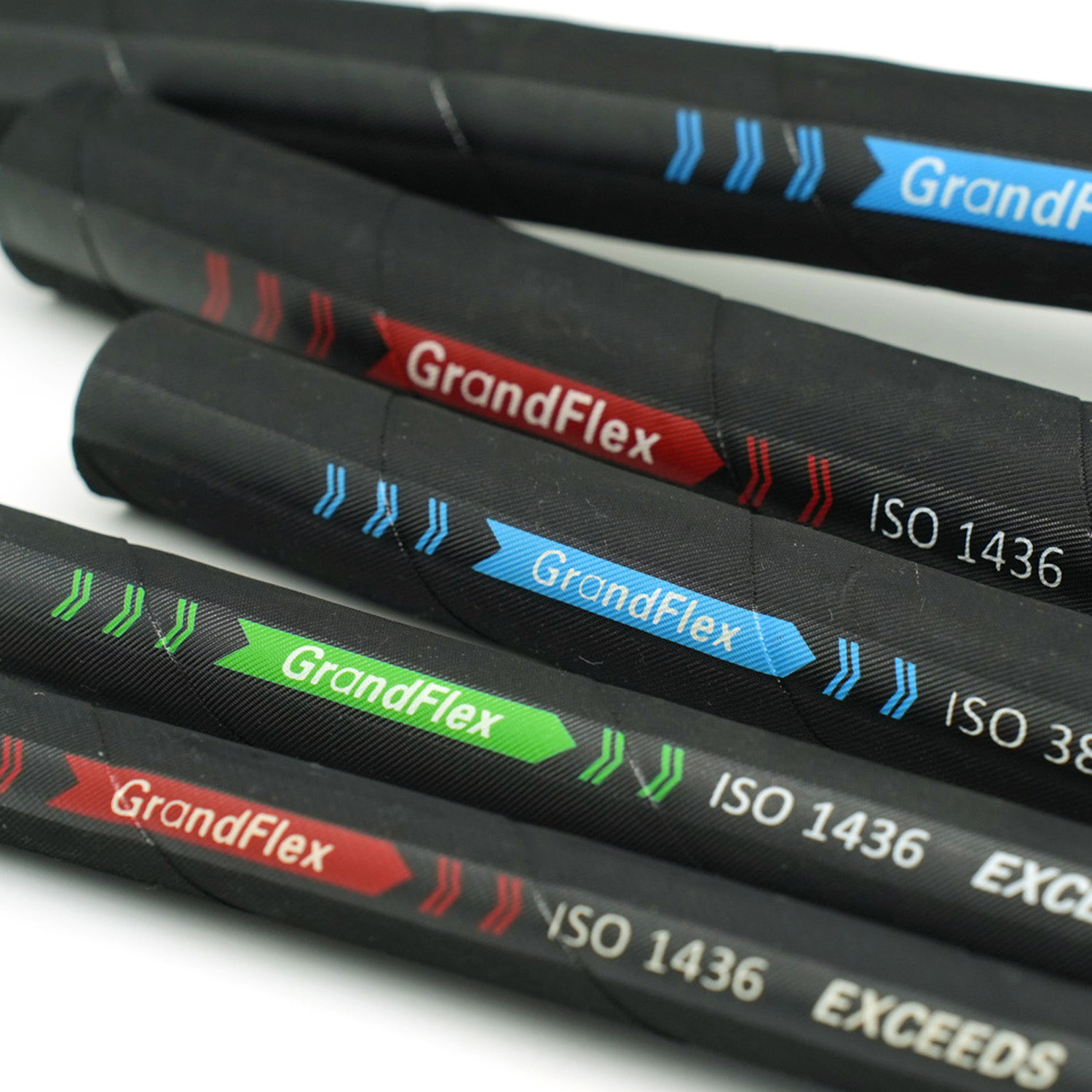
The inner tube of a hose is the primary contact point for the conveyed fluid, making its material composition a critical factor in the hose's overall performance and longevity. The Grandflex hose is constructed with a black oil-resistant synthetic rubber inner tube. This specific material is chosen for its excellent compatibility with both petroleum and water-based hydraulic fluids. The oil-resistant properties of the synthetic rubber prevent the inner tube from swelling, degrading, or becoming brittle when exposed to these fluids over extended periods. This compatibility ensures that the fluid remains uncontaminated and that the hose maintains its structural integrity, even under continuous use in high-pressure industrial systems.
The reinforcement layer is the backbone of any high-pressure hose, providing the strength needed to contain the internal forces generated by hydraulic systems. The Grandflex hose features two braids of high-tensile steel wire reinforcement. This robust construction allows the hose to support a wide range of working pressures, from 8.0 Mpa (1160 Psi) to 41.5 Mpa (6018 Psi), depending on the specific size of the hose. In addition to its impressive working pressure range, the hose boasts a burst pressure range of 32 Mpa to 165 Mpa. The burst pressure represents the maximum internal pressure the hose can withstand before catastrophic failure occurs, providing a significant safety margin for industrial operations.
The outer cover of a hose serves as the first line of defense against environmental hazards and mechanical wear. The Grandflex hose features a black synthetic rubber cover that is specifically formulated to be resistant to oil, corrosion, and abrasion. In industrial environments, hoses are frequently exposed to harsh chemicals, rough surfaces, and moving machinery. The abrasion-resistant properties of the cover protect the underlying steel wire reinforcement from physical damage, while the oil and corrosion resistance ensure that the hose does not degrade when exposed to environmental contaminants. This durable outer cover significantly extends the service life of the hose, reducing the need for frequent replacements and minimizing downtime.
Proper sizing is essential for the effective operation of any hydraulic system. Using a hose with incorrect dimensions can lead to pressure drops, restricted flow, and premature failure. The Grandflex DIN EN853 2SN / SAE 100R2AT is available in a wide range of sizes to accommodate various industrial requirements. The careful calibration of these dimensions ensures compatibility with standard fittings and machinery components.
To meet the diverse needs of global industries, the Grandflex hose is manufactured in multiple sizing standards. The available metric sizes range from 5.0 mm to 51.0 mm, providing precise options for systems designed around metric specifications. For systems utilizing imperial measurements, the available inch sizes range from 3/16" to 2". Additionally, the hose is categorized by SAE Dash sizes, ranging from 03 to 30. This comprehensive range of sizes ensures that engineers and technicians can select the exact hose dimensions required for their specific applications, whether they are working on compact mobile hydraulics or large-scale construction machinery.
Sizing Standard |
Minimum Size |
Maximum Size |
|---|---|---|
Metric Sizes |
5.0 mm |
51.0 mm |
Inch Sizes |
3/16" |
2" |
SAE Dash Sizes |
03 |
30 |
The physical performance of a hose is determined by its pressure ratings, flexibility, and weight. These metrics are critical for ensuring that the hose can be installed correctly and operate safely within the constraints of the machinery. The Grandflex hose is engineered to provide an optimal balance of strength and flexibility, making it suitable for complex routing in tight spaces.
As previously mentioned, the working pressure range of the Grandflex hose is 8.0 Mpa (1160 Psi) to 41.5 Mpa (6018 Psi), with a burst pressure range of 32 Mpa to 165 Mpa. These pressure ratings are achieved through the dual-layer high-tensile steel wire braid reinforcement. It is crucial for operators to select a hose size that meets the specific pressure requirements of their system to ensure safe and reliable operation.
Flexibility is a key consideration in mobile hydraulics and construction machinery, where hoses must often navigate around moving parts and tight corners. The Grandflex hose offers a bending radius range of 90 mm to 630 mm. This flexibility allows for easier installation and reduces the mechanical stress on the hose and fittings during operation. Additionally, the weight range of the hose is 0.32 Kg/m to 3.42 Kg/m. The weight of the hose is an important factor in mobile applications, where minimizing overall equipment weight can improve efficiency and performance.
Compliance with recognized industry standards is essential for verifying the quality, safety, and performance of industrial hoses. The Grandflex DIN EN853 2SN / SAE 100R2AT is engineered and certified to meet stringent international specifications, ensuring that it delivers reliable performance in critical applications.
The Grandflex hose is engineered to DIN EN853 2SN and SAE 100R2AT standards. These standards dictate the construction, dimensions, and performance requirements for wire-braid reinforced hydraulic hoses. Compliance with these standards guarantees that the hose is capable of handling the specified pressures and environmental conditions. Furthermore, the hose is certified to ISO 1436 and SAE J517. These additional certifications provide further assurance of the hose's quality and reliability, making it appropriate for industrial equipment requiring SAE 100R2AT compliance.
The robust construction and comprehensive certifications of the Grandflex hose make it suitable for a wide variety of demanding industrial applications. Its ability to handle high pressures, resist environmental damage, and convey petroleum and water-based fluids makes it an indispensable component in many sectors.
One of the primary use cases for the Grandflex hose is in mobile hydraulics and construction machinery. These applications require hoses that can withstand continuous movement, high pressure pulses, and exposure to harsh outdoor environments. The dual-layer high-tensile steel wire braid reinforcement provides the necessary strength, while the black oil, corrosion, and abrasion-resistant synthetic rubber cover protects the hose from damage caused by rocks, debris, and weather. The hose's flexibility, indicated by its bending radius range of 90 mm to 630 mm, allows it to be routed efficiently through the complex mechanical structures of excavators, loaders, and other heavy equipment. Furthermore, the male NPT end fittings ensure leak-resistant connections, which is critical for maintaining the operational efficiency and safety of these machines.
While the Grandflex hose is designed for durability, proper maintenance and regular inspection are essential for maximizing its service life and preventing unexpected failures. Industrial environments can be exceptionally harsh, and even the most robust hoses can experience wear over time.
Regular visual inspections of the spiral hose should be conducted to identify any signs of damage to the outer cover. Operators should look for abrasions, cuts, or areas where the steel wire reinforcement is exposed. The black synthetic rubber cover is resistant to oil, corrosion, and abrasion, but severe mechanical impact can still cause damage. Additionally, the male NPT end fittings should be checked for signs of leakage or corrosion. Ensuring that the hose is not subjected to bending beyond its specified bending radius range of 90 mm to 630 mm will also help prevent premature failure. By adhering to these maintenance practices, operators can ensure the continued reliability of their high-pressure industrial systems.
The DIN EN853 2SN / SAE 100R2AT provides exceptional value for high-pressure industrial systems, mobile hydraulics, and construction machinery through its robust dual-layer high-tensile steel wire braid reinforcement and durable black synthetic rubber construction. By offering broad compatibility with petroleum and water-based fluids, alongside strict adherence to DIN EN853 2SN, SAE 100R2AT, ISO 1436, and SAE J517 standards, this product ensures safe, leak-resistant operations via its male NPT end fittings across a wide range of metric, inch, and SAE Dash sizes, making it an indispensable solution for professionals demanding reliable fluid conveyance under extreme working pressures.


