Selecting the right hydraulic hose determines whether fluid transfer systems run safely or face unexpected downtime, fluid leaks, and costly component failures. Mechanics, industrial engineers, and procurement specialists frequently evaluate SAE 100R1 Vs SAE 100R2 Hydraulic Hose: What Is The Difference? to determine which hose matches their equipment pressure requirements and bend radius constraints.
While both lines belong to the standard SAE J517 specification series, their internal steel wire reinforcement layers, burst safety factors, operating pressure limits, and structural flexibilities differ substantially. Miscalculating these structural distinctions leads to burst lines, compromised flow rates, and safety hazards on jobsites.
Below is a detailed engineering analysis comparing SAE 100R1 and SAE 100R2 hydraulic hoses, complete with pressure rating tables, structural breakdowns, selection parameters, and insights from B2B industrial manufacturing experience.
Understanding the physical construction of SAE 100R1 and SAE 100R2 reveals why their performance capabilities diverge. Both lines consist of three fundamental layers: an inner oil-resistant synthetic rubber tube, a reinforcement layer, and a weather- or abrasion-resistant outer cover. The defining distinction lies in the reinforcement core.
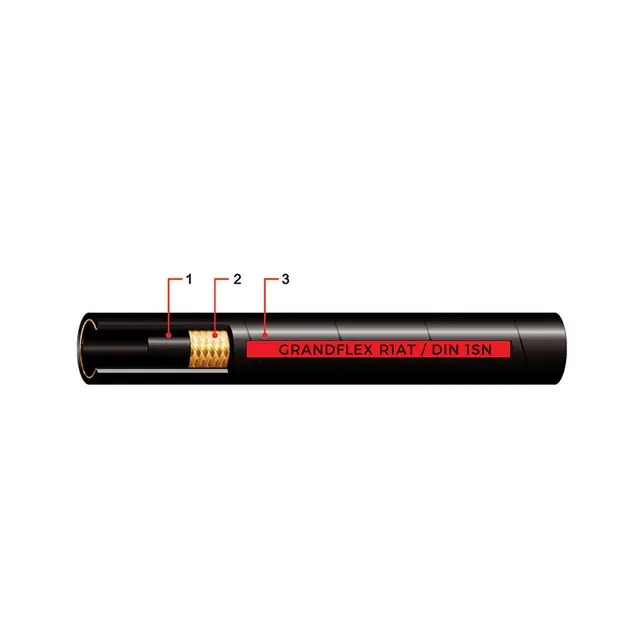
SAE 100R1 Construction: Inner Rubber Tube -> 1 Layer of High-Tensile Steel Wire Braid -> Synthetic Rubber Outer Cover.
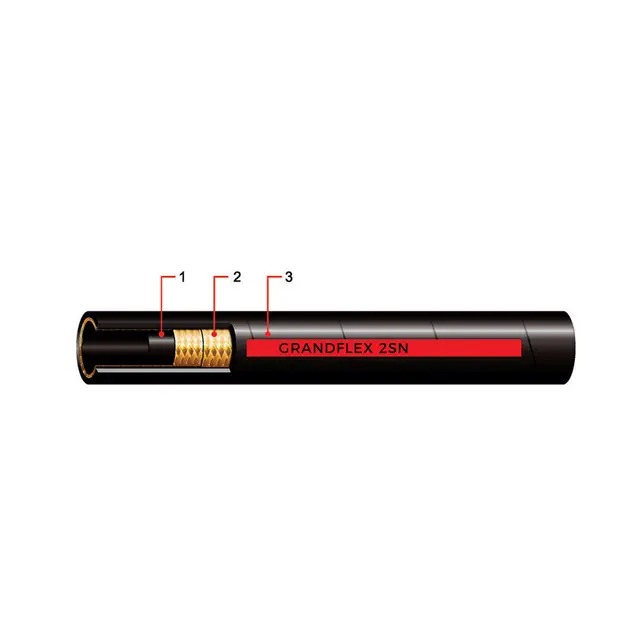
SAE 100R2 Construction: Inner Rubber Tube -> 2 Layers of High-Tensile Steel Wire Braid (separated by insulating synthetic cushion layer) -> Synthetic Rubber Outer Cover.
SAE 100R1 features a single braid of high-tensile steel wire over the inner rubber lining. It provides medium-pressure resistance while maintaining high flexibility and a lighter total weight per meter.
SAE 100R2 incorporates two distinct layers of high-tensile steel wire braiding separated by an insulating rubber cushion layer. This second braid layer nearly doubles its maximum operating pressure rating compared to an equivalent nominal ID size in SAE 100R1.
Working pressure limits are the single most critical factor when choosing between these two hose standards. Operating an SAE 100R1 line above its rated working pressure degrades the single braid structural integrity, causing fatigue and premature bursting.
Nominal Size (Dash Size) | Inner Diameter (Inches / mm) | SAE 100R1 Max Working Pressure (PSI / Bar) | SAE 100R2 Max Working Pressure (PSI / Bar) | SAE 100R1 Min Bend Radius (mm) | SAE 100R2 Min Bend Radius (mm) |
-04 | 1/4" (6.4 mm) | 3,270 PSI / 225 Bar | 5,800 PSI / 400 Bar | 100 mm | 100 mm |
-06 | 3/8" (9.5 mm) | 2,610 PSI / 180 Bar | 4,780 PSI / 330 Bar | 130 mm | 130 mm |
-08 | 1/2" (12.7 mm) | 2,320 PSI / 160 Bar | 3,980 PSI / 275 Bar | 180 mm | 180 mm |
-12 | 3/4" (19.0 mm) | 1,520 PSI / 105 Bar | 3,110 PSI / 215 Bar | 240 mm | 240 mm |
-16 | 1" (25.4 mm) | 1,280 PSI / 88 Bar | 2,390 PSI / 165 Bar | 300 mm | 300 mm |
-32 | 2" (50.8 mm) | 580 PSI / 40 Bar | 1,160 PSI / 80 Bar | 630 mm | 630 mm |
(Note: Technical ratings reflect standard SAE J517 guidelines . Always verify manufacturer datasheets for exact tolerances.)
Pressure Capacity: SAE 100R2 hoses handle roughly 75% to 100% higher working pressures across equivalent inner diameters compared to SAE 100R1 hoses.
Burst Safety Factor: Standard industrial designs maintain a 4:1 safety factor (burst pressure is 4 times higher than working pressure) for both R1 and R2 lines.
Temperature Resistance: Both hose standards generally perform within a range of -40°F to +212°F (-40°C to +100°C) for petroleum-based hydraulic fluids.
While SAE 100R2 handles elevated pressures, that extra steel wire braid adds weight and structural stiffness. In compact engine bays or mobile agricultural units, physical routing requirements often dictate hose selection as strongly as pressure metrics.
SAE 100R1: Weighs significantly less per foot and exhibits lower resistance to bending. Systems requiring tight manual installation or lightweight mobile booms benefit from R1's single-braid profile.
SAE 100R2: The second wire braid increases overall wall thickness and rigid tensile force. Routing an R2 hose through tight curves requires greater force, which can put additional stress on end fittings if bend radius limits are violated.
While published minimum bend radii for R1 and R2 are often similar under static conditions, SAE 100R1 flexes more dynamically under fluid pulses. If routing space is constrained and operating pressures remain under medium thresholds, SAE 100R1 reduces structural strain on equipment manifolds.
Choosing between SAE 100R1 and SAE 100R2 comes down to matching hose capabilities with specific application demands.
Low- to Medium-Pressure Return Lines: Transferring hydraulic fluid back to reservoirs or tanks where pressure spikes are minimal.
Auxiliary Steering & Lift Circuits: Small tractors, forklifts, and light agricultural implements operating under 2,500 PSI.
Pneumatic & Low-Pressure Industrial Tools: Powering air tools, factory fluid transfer systems, and lubricated air supply lines.
Weight-Sensitive Machinery: Aerial work platforms, boom lifts, and light mobile machinery where minimizing assembly weight improves efficiency.
High-Pressure Main Hydraulic Lines: Powering hydraulic cylinders, main pumps, and heavy motors on excavators, bulldozers, and loaders.
Heavy Industrial Press Machinery: Injection molding machines, metal stamping presses, and high-tonnage jacks prone to frequent pressure spikes.
Mining & Rig Drilling Equipment: Systems operating continuously near high pressure limits where maximum burst protection is required.
Hydrostatic Drives: Heavy-duty fluid drives experiencing severe load shifts and rapid fluid acceleration.
Hydraulic systems do not operate in isolation on modern jobsites. Major industrial projects, mining sites, and agricultural facilities combine high-pressure hydraulic circuits with high-volume fluid discharge and transfer networks.
While SAE 100R1 and 100R2 handle high-pressure hydraulic oil transfer, low-pressure high-volume water discharge, slurry movement, and drainage rely on specialized PVC lay flat hoses.
Dewatering and Fluid Transfer: Dewatering pumps driven by high-pressure SAE 100R2 hydraulic motors often discharge large volumes of water through heavy-duty PVC lay flat hoses.
Storage and Flexibility: Modern PVC lay flat hoses roll flat when depressurized, making them easy to transport alongside mobile hydraulic machinery.
Fluid Compatibility: Hydraulic hoses move synthetic and petroleum oils, whereas high-quality PVC lay flat hoses handle water, mild chemicals, and slurry runoff without cross-contaminating hydraulic oil reservoirs.
Selecting innovative PVC lay flat hoses engineered with reinforced synthetic fibers ensures site-wide fluid transfer runs reliably alongside primary hydraulic machinery. In secondary containment setups, using high transparency monitoring lines or heavy-duty PVC lay flat hoses allows operators to inspect fluid movement without stopping main hydraulic pumps.
Procurement managers must balance upfront component costs with long-term reliability to minimize overall downtime.
Initial Material Cost: SAE 100R1 typically costs 20% to 35% less than SAE 100R2 of equal diameter due to lower steel content and faster production speeds.
Downtime Risks: Installing an R1 hose in an application with pressure surges above its rated limit to save money often leads to premature failure. Replacing a blown hose and hydraulic fluid costs significantly more than the initial savings.
Fitting Standard Compatibility: Both R1 and R2 hoses utilize standard crimp fittings (such as SAE 100R1AT and SAE 100R2AT standard crimp collars), keeping assembly tooling costs identical.
At Qingdao Grantseed Rubber Co., Ltd., we take immense pride in our role as a primary B2B manufacturer of high-caliber rubber and fluid conveyance solutions. Operating out of our modern production facility in Qingdao, China, we combine state-of-the-art automated extruders, precision wire-braiding machinery, and strict ISO 9001:2008 quality controls to manufacture products that power heavy industry worldwide. We produce high-pressure hydraulic hoses complying with SAE J517 standards—including SAE 100R1AT and 100R2AT—alongside versatile PVC lay flat hoses for agricultural irrigation and industrial dewatering.
Our factory capabilities extend to full OEM customization, where we engineer tailored hose pressure ratings, custom continuous lengths, and abrasion-resistant synthetic covers suited for harsh mining and construction environments. Exporting across North America, Europe, Southeast Asia, and the Middle East, we provide B2B clients with complete quality traceability, bulk factory-direct pricing, and rigorous testing on every production batch before shipment.
Understanding SAE 100R1 Vs SAE 100R2 Hydraulic Hose: What Is The Difference? comes down to matching line pressure requirements, weight constraints, and flexibility needs. SAE 100R1 provides a flexible, lightweight, cost-effective solution for medium-pressure return lines and steering circuits. SAE 100R2 delivers the double-wire braided strength required for high-pressure main pumps, heavy construction equipment, and demanding industrial applications.
Matching your hydraulic lines with durable auxiliary transfer equipment—such as PVC lay flat hoses—ensures reliable, efficient fluid conveyance across your entire jobsite.
Yes, substituting an SAE 100R2 hose in place of an SAE 100R1 hose is generally safe because R2 handles higher working pressures. However, consider that the R2 hose is slightly heavier and stiffer, which may affect tight bend routing.
No, you should never replace an SAE 100R2 hose with an SAE 100R1 hose unless the circuit's maximum pressure is well within the lower working pressure rating of the R1 hose. Installing an R1 hose in a high-pressure R2 application can lead to line failure or bursting.
The "AT" suffix indicates that the hose has a non-skive outer cover. Non-skive covers allow crimp fittings to be attached directly over the outer rubber layer without stripping (skiving) it beforehand, simplifying assembly and reducing labor costs.
While both handle fluid conveyance, they serve different purposes within a system. Hydraulic hoses handle high-pressure petroleum- or synthetic-based hydraulic oils, whereas PVC lay flat hoses are designed for low-pressure water, fluid discharge, and dewatering applications.