

Views: 0 Author: Site Editor Publish Time: 2026-06-29 Origin: Site


The landscape of fluid power transmission is continually evolving, demanding higher performance, greater reliability, and more streamlined selection processes for engineers designing complex machinery. At the heart of these systems is the Hydraulic Hose, a critical component responsible for conveying energy-transmitting fluids under extreme pressures and challenging environmental conditions. Historically, engineers have relied on a patchwork of regional standards to specify these components, often leading to confusion when designing equipment for global markets. The introduction of the ISO 18752 standard represents a paradigm shift, simplifying the selection process by categorizing hoses based on maximum working pressure and impulse cycle life rather than construction methods. This performance-based approach allows designers to focus on the actual operational requirements of their systems, ensuring optimal safety and efficiency. However, understanding traditional standards like DIN EN 856 remains essential, as many high-performance products, such as the DIN EN856 4SH model manufactured by Grantseed Rubber, continue to dominate heavy-duty applications.

High-performance hydraulic hoses are essential for reliable fluid power transmission in demanding industrial applications.
For decades, the fluid power industry navigated a complex web of specifications. The Society of Automotive Engineers (SAE) in North America and the Deutsches Institut für Normung (DIN) in Europe established the foundational frameworks for hose manufacturing. These legacy standards primarily dictated the construction of the hose—specifying the number of wire braids or spirals, the dimensions, and the materials. While effective for standardizing manufacturing, this approach often forced engineers to over-specify or under-specify based on construction rather than actual application demands. The ISO 18752 standard addresses this by shifting the focus entirely to performance metrics. By classifying hoses by their pressure ratings and testing them to specific impulse cycles, ISO 18752 provides a universal language for engineers worldwide. This harmonization reduces inventory complexity, simplifies cross-border equipment manufacturing, and ensures that a hose selected for a specific pressure will perform reliably, regardless of its internal construction.
The transition from construction-based standards to performance-based standards marks a significant milestone in mechanical engineering. In the past, an engineer might specify a two-wire braid hose simply because that was the industry norm for a particular pressure range, even if a newer, lighter, single-wire hose could achieve the same performance. This reliance on construction types limited innovation and made it difficult to integrate new materials and manufacturing techniques. The DIN standards, particularly those governing spiral wire reinforcement, set a high bar for heavy-duty applications. The EN 856 standard, for example, is renowned for its rigorous requirements for high-pressure, high-impulse environments. Understanding the interplay between these traditional benchmarks and the modern ISO 18752 framework is crucial for any engineer tasked with fluid power system design.
The development of ISO 18752 was driven by the need for a unified, global standard that could accommodate the rapid advancements in synthetic rubber compounds and high-tensile steel wire. SAE J517 and DIN EN 853/856 have long been the cornerstones of hose specification. SAE standards typically categorize hoses by a two-digit dash size representing the inner diameter in sixteenths of an inch, alongside construction types like 100R1, 100R2, and 100R12. DIN standards, conversely, focus heavily on metric dimensions and specific European testing protocols. ISO 18752 bridges this gap by creating pressure classes ranging from 3.5 MPa to 56.0 MPa. Each class is further divided into grades based on impulse resistance, typically 500,000 or 1,000,000 cycles at elevated temperatures. This means an engineer only needs to know the system's maximum operating pressure and the expected severity of pressure spikes to select the appropriate hose class, drastically reducing the margin for error in the specification process.
In today's interconnected global economy, heavy machinery manufactured in one country is frequently exported, operated, and maintained in another. When equipment relies on regionally specific hose standards, sourcing replacement parts can become a logistical nightmare, leading to extended downtime and increased maintenance costs. Global standardization through ISO 18752 ensures that a replacement hose meeting the required pressure and impulse grade can be sourced anywhere in the world, regardless of the original manufacturer's construction method. Furthermore, it encourages manufacturers to innovate. If a company can achieve a 42.0 MPa pressure rating using lighter materials or fewer reinforcement layers while still passing the ISO impulse tests, they can offer a more flexible, easier-to-install product without compromising safety or compliance. This competitive drive ultimately benefits the end-user through improved product performance and reduced overall system weight.
To fully leverage the benefits of ISO 18752, engineers must understand its core classification mechanisms. The standard is built upon the premise that the most critical factors in hose failure are continuous high pressure, severe pressure impulses, and temperature extremes. By testing hoses against these specific parameters, the standard provides a highly accurate prediction of field performance. The selection process begins with a thorough analysis of the hydraulic circuit, identifying the maximum continuous working pressure, the frequency and magnitude of pressure spikes (impulses), the ambient and fluid temperatures, and the physical routing constraints that dictate the required bend radius.
The defining feature of ISO 18752 is its constant pressure classification system. Under traditional standards like SAE 100R1 or 100R2, the maximum working pressure of a hose decreases as the inner diameter increases. For example, a 1/4-inch hose might be rated for 4000 psi, while a 1-inch hose of the same construction type might only be rated for 2000 psi. This variable pressure rating complicates system design, as engineers must constantly cross-reference sizes and pressures. ISO 18752 eliminates this complexity by establishing pressure classes that remain constant across all hose sizes. If an engineer specifies an ISO 18752 Class 280 hose, they are guaranteed a maximum working pressure of 28.0 MPa (approximately 4000 psi) whether the hose is 1/4-inch or 2 inches in diameter. This uniformity allows for much faster and more intuitive system design, particularly in complex manifolds where multiple hose sizes operate under the same system pressure.
Hydraulic systems rarely operate at a constant, static pressure. Actuating cylinders, shifting valves, and varying loads create rapid pressure spikes, known as impulses, which subject the hose to severe mechanical stress. Fatigue from these impulses is a primary cause of hose failure. ISO 18752 addresses this by categorizing hoses into grades based on their ability to withstand impulse cycles. The standard defines specific impulse curves, dictating the rate of pressure rise, the peak pressure (often 120% or 133% of the maximum working pressure), and the rate of pressure drop. Hoses are subjected to these cycles at their maximum rated operating temperature. A standard grade hose might be required to survive 500,000 cycles, while a high-performance grade must endure 1,000,000 cycles. By selecting a hose with an appropriate impulse grade, engineers can significantly extend the service life of the equipment and reduce the risk of catastrophic failure in the field.
While standards provide the framework, the actual specification of a fluid power conduit requires a deep understanding of mechanical engineering principles. The hose must act as a flexible pressure vessel, capable of containing highly pressurized fluid while simultaneously flexing to accommodate machine movement. This requires a careful balancing act between strength, flexibility, and chemical compatibility. Engineers must evaluate the dynamic forces at play within the hydraulic circuit, including fluid velocity, volumetric flow rate, and the potential for cavitation or fluid hammer. Furthermore, the physical environment in which the machinery operates imposes external stresses, such as abrasion, UV exposure, and extreme ambient temperatures, all of which must be accounted for in the selection process.
Determining the correct maximum working pressure is the most critical step in hose specification. The selected hose must have a rated working pressure equal to or greater than the maximum system pressure, including any anticipated pressure spikes or relief valve settings. It is a fundamental engineering rule never to exceed the manufacturer's maximum working pressure rating. Standard practice in the fluid power industry involves a 4:1 safety factor for dynamic hydraulic applications. This means the minimum burst pressure of the hose is at least four times the maximum working pressure. This safety margin accounts for manufacturing tolerances, material degradation over time, and unexpected operational anomalies. When specifying high-pressure components, engineers must also consider the pressure ratings of the attached fittings and adapters, as the overall assembly is only as strong as its weakest link.
Temperature profoundly affects the physical properties of elastomeric materials used in hose construction. Operating a hose above its maximum rated temperature accelerates the aging process of the synthetic rubber, leading to hardening, cracking, and eventual failure. Conversely, operating below the minimum rated temperature causes the elastomers to become brittle and prone to fracturing when flexed. The temperature rating must account for both the internal fluid temperature and the external ambient temperature. In high-performance applications, the friction generated by fluid flowing through the system, combined with the heat generated by pumps and valves, can significantly elevate the fluid temperature. Engineers must carefully evaluate the thermal dynamics of the entire system and select a hose with a temperature range that comfortably encompasses the anticipated extremes.
The minimum bend radius is a critical geometric constraint in fluid power routing. It defines the tightest arc the hose can achieve without compromising its structural integrity or restricting fluid flow. Bending a hose tighter than its specified minimum bend radius places excessive stress on the reinforcement layers, potentially causing the wire to kink, separate, or fatigue prematurely. It also flattens the inner tube, reducing the cross-sectional area and creating a pressure drop that reduces system efficiency. Proper routing requires careful planning to ensure all bends are well within the manufacturer's limits. Engineers use techniques such as utilizing angled fittings, providing adequate slack for machine movement, and employing hose clamps to support the assembly and prevent tight bends near the termination points. Optimizing the routing not only extends the life of the hose but also improves the overall aesthetics and maintainability of the machinery.
The longevity of a fluid power assembly is heavily dependent on the chemical compatibility between the hose materials and the fluids it conveys, as well as its resistance to external environmental factors. The inner tube must remain inert when exposed to the hydraulic medium, preventing swelling, degradation, or the leaching of compounds that could contaminate the system. Simultaneously, the outer cover must serve as a robust barrier against physical damage and environmental degradation. The selection of synthetic rubber compounds is a highly specialized science, requiring manufacturers to balance various chemical properties to achieve the desired performance characteristics.
The vast majority of industrial and mobile hydraulic systems utilize petroleum-based fluids. These mineral oils provide excellent lubricity, heat dissipation, and corrosion protection for the internal components of pumps, valves, and cylinders. However, petroleum products can aggressively attack certain types of rubber, causing them to swell, soften, and lose their mechanical strength. Therefore, the inner tube of a hydraulic conduit must be specifically formulated to resist petroleum degradation. Nitrile rubber (NBR) and Neoprene are commonly used synthetic elastomers that offer excellent resistance to mineral oils. Ensuring strict compatibility between the specific fluid chemistry and the inner tube material is paramount; failure to do so can result in rapid hose deterioration, system contamination from degraded rubber particles, and ultimately, catastrophic system failure.
While the inner tube handles the internal chemical environment, the outer cover must withstand the harsh realities of the external world. In heavy-duty applications such as construction and mining, hoses are constantly subjected to abrasion from rubbing against machine frames, other hoses, or debris. The cover material must be exceptionally tough and wear-resistant to protect the underlying wire reinforcement. Furthermore, exposure to sunlight (UV radiation) and ozone can cause synthetic rubber to oxidize, leading to surface cracking and premature aging. Weather resistance is crucial for outdoor machinery that operates in diverse climates. Manufacturers often utilize specialized synthetic rubber blends, such as Chloroprene or EPDM, for the cover to provide superior resistance to abrasion, weather, ozone, and cut damage, ensuring the hose remains protected throughout its intended service life.
When engineering requirements dictate extreme pressure capabilities combined with robust environmental resistance, professionals frequently turn to specialized constructions that meet rigorous European standards. The DIN EN856 4SH Hydraulic Hose, manufactured by Grantseed Rubber, exemplifies this tier of high-performance fluid power components. Designed specifically to handle very high-pressure hydraulic service, this model integrates advanced materials and structural engineering to deliver reliable performance in the most demanding industrial environments. By examining the specific construction and material properties of the DIN EN856 4SH, engineers can better understand how it fulfills the stringent requirements of heavy-duty applications.
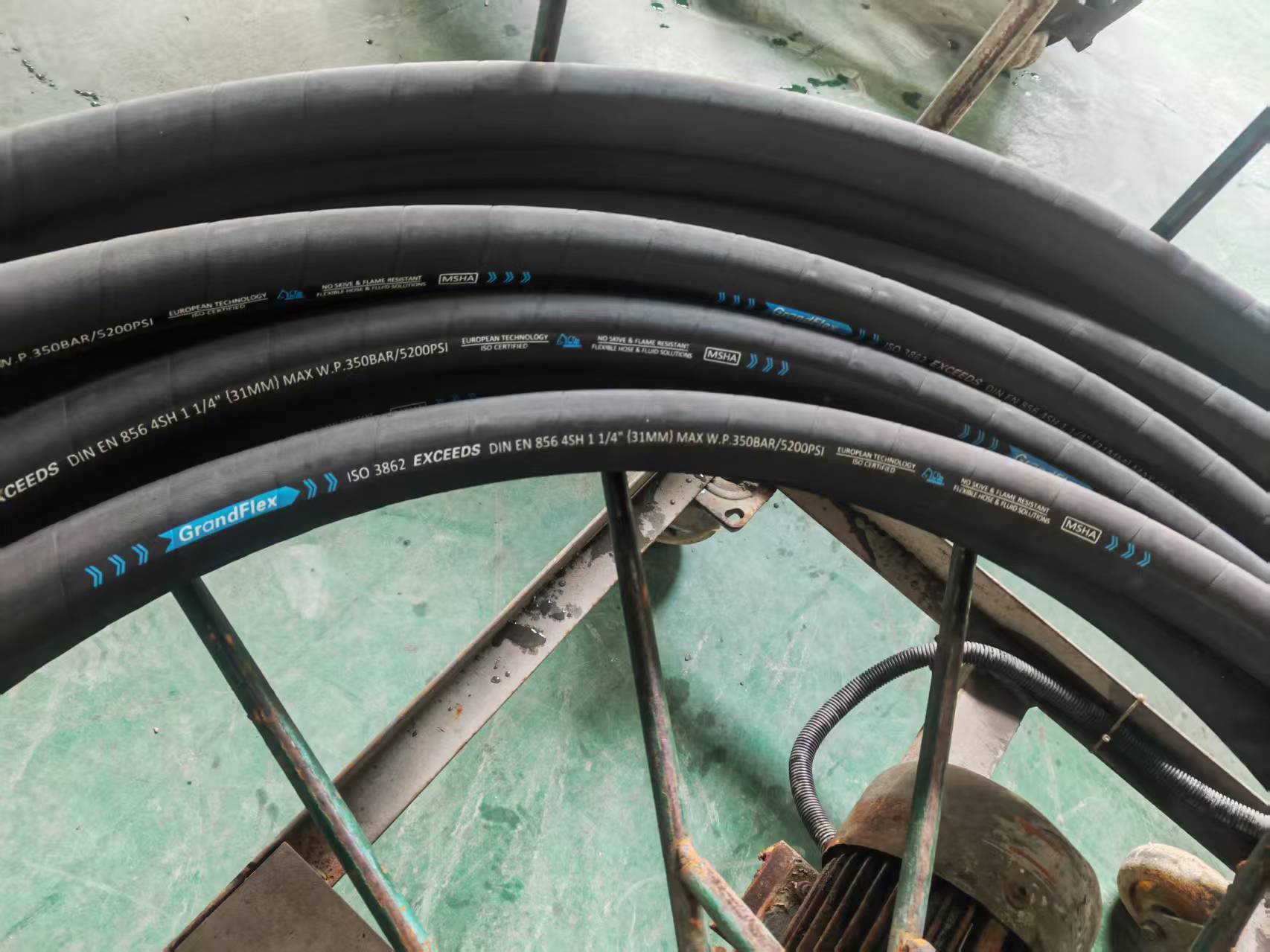
The defining characteristic of the DIN EN856 4SH model is its robust reinforcement architecture. Unlike braided hoses, which interweave wires in a crisscross pattern, spiral hoses utilize layers of wire wrapped in alternating directions. The Grantseed Rubber DIN EN856 4SH is reinforced with four layers of high-tensile spiral steel wire. This spiral construction is specifically engineered to support very high-pressure hydraulic service. The alternating layers of high-tensile steel provide exceptional hoop strength, preventing the hose from expanding or bursting under extreme internal pressure. Furthermore, spiral reinforcement significantly improves the hose's resistance to pressure impulses, as the wires do not rub against each other during pressure fluctuations as they do in braided constructions. This structural integrity is vital for machinery that experiences constant, severe pressure spikes during operation.
The performance of the DIN EN856 4SH is further enhanced by its specialized synthetic rubber compounds. The hose features a black synthetic rubber inner tube that is specifically formulated to resist abrasion, corrosion, and oil. This ensures long-term compatibility and prevents degradation when conveying aggressive hydraulic media. Protecting the high-tensile steel wire is a black synthetic rubber cover engineered for maximum durability. This cover resists abrasion, weather, ozone, oil, cut damage, and aging. The combination of these specific synthetic rubber formulations ensures that the hose maintains its flexibility and structural integrity even when exposed to harsh environmental conditions, accidental impacts, and continuous mechanical wear in industrial settings.
Proper application of the DIN EN856 4SH requires strict adherence to its verified specifications. The hose complies fully with the EN 856 4SH standard, ensuring consistent performance and dimensional accuracy. It is designed to operate within a specific temperature range of -40°C to +100°C, making it suitable for a wide variety of climates and operational environments. However, engineers must note that the operating temperature is strictly limited to this range, and the hose is designed specifically for petroleum-based hydraulic fluids. Understanding the precise capabilities of each size variant is crucial for accurate system design.
The DIN EN856 4SH is available in several sizes, each with specific performance metrics that engineers must integrate into their system designs. The specifications for the available sizes are as follows:
19mm (3/4 inch) Size: This size offers a Max Working Pressure of 42.0 MPa (6090 psi). It has a Min Bend Radius of 280.0 mm and a Weight of 1.64 Kg/m.
25mm (1 inch) Size: This variant provides a Max Working Pressure of 38.0 MPa (5510 psi), with a Min Bend Radius of 340.0 mm and a Weight of 2.03 Kg/m.
31.5mm (1-1/4 inch) Size: Designed for larger flow requirements, this size has a Max Working Pressure of 32.5 MPa (4713 psi), a Min Bend Radius of 460.0 mm, and a Weight of 2.45 Kg/m.
38mm (1-1/2 inch) Size: This size features a Max Working Pressure of 29.0 MPa (4205 psi), a Min Bend Radius of 560.0 mm, and a Weight of 3.35 Kg/m.
51mm (2 inch) Size: The largest specified size offers a Max Working Pressure of 25.0 MPa (3625 psi), a Min Bend Radius of 700.0 mm, and a Weight of 4.50 Kg/m.
These metrics demonstrate the inverse relationship between hose diameter and maximum working pressure inherent in the EN 856 standard, requiring careful calculation during the specification process to ensure the selected size meets both the flow and pressure requirements of the hydraulic circuit.
A high-pressure hose is only effective if it can be securely and reliably connected to the rest of the hydraulic system. The termination points are critical stress areas where leaks and blow-offs are most likely to occur. The DIN EN856 4SH boasts extensive compatibility with a wide array of industry-standard fittings, ensuring seamless integration into diverse machinery designs. It is verified to be compatible with multiple fitting standards including DKM, DKL, DKOL, DKS, DKOS, DKR, DKRO, ORFS, JIC 37°, SFL, SFS, Female CM, CORFS, CJIC 37°, CEL, CES, and Banjo. This broad compatibility allows engineers to utilize the DIN EN856 4SH across various equipment platforms without needing to redesign manifolds or adapt existing connection points, thereby streamlining the manufacturing and maintenance processes.
The robust construction and high-pressure capabilities of the DIN EN856 4SH make it an indispensable component in industries that rely on heavy-duty fluid power. These environments demand components that can withstand continuous operation, extreme mechanical stress, and harsh external conditions without failure. The verified use cases for this specific model highlight its versatility and strength across multiple sectors.
In the construction industry, machinery such as excavators, bulldozers, and wheel loaders rely on high-pressure hydraulics to perform heavy lifting and earthmoving tasks. The DIN EN856 4SH is ideally suited for construction machinery, where it must endure severe pressure impulses and constant abrasion from dirt and debris. Similarly, mining and quarry equipment operate in some of the most unforgiving environments on earth. The four layers of high-tensile spiral steel wire provide the necessary burst resistance for the extreme pressures required to crush rock and move massive payloads, while the tough synthetic rubber cover protects against the abrasive dust and sharp rocks prevalent in these operations.
The energy sector, particularly oil and gas extraction, utilizes complex hydraulic systems for drilling rigs, wellhead control panels, and blowout preventers. The DIN EN856 4SH is verified for use in oilfield hydraulic systems, where reliability is paramount for safety and environmental protection. Furthermore, it is extensively used in transport and mobile hydraulic equipment, providing the necessary fluid power for steering, braking, and lifting mechanisms in heavy commercial vehicles. Industrial hydraulic units and outdoor heavy-duty machinery also benefit from the hose's ability to operate effectively within the -40°C to +100°C temperature range, ensuring consistent performance regardless of seasonal weather fluctuations or demanding factory conditions.
Proper specification is only the first step in ensuring the longevity and safety of a fluid power system. Correct installation procedures and ongoing maintenance are equally critical. A poorly installed hose, even one of the highest quality, will fail prematurely. Furthermore, the ability to customize the product to specific operational needs can significantly enhance system efficiency and simplify assembly processes.
To guarantee optimal performance and safety, rigorous preparation is required before finalizing a component specification. For the DIN EN856 4SH, specific parameters must be verified. Size, pressure requirement, operating temperature, fitting type, required length, and packing method must be confirmed prior to ordering. This comprehensive confirmation process ensures that the selected hose precisely matches the engineering demands of the application. It prevents costly errors, such as specifying a hose with an inadequate pressure rating or an incompatible fitting standard, which could lead to project delays or unsafe machinery operation.
Recognizing that industrial applications often require tailored solutions, Grantseed Rubber provides comprehensive services to support engineers and procurement teams. Custom support options include custom length supply, allowing manufacturers to order hoses pre-cut to exact specifications, reducing waste and assembly time. Furthermore, printing or branding services are available, enabling equipment manufacturers to label hoses with part numbers, safety warnings, or corporate logos for easier identification and maintenance. The manufacturer also offers hose assembly cooperation, providing fully crimped and tested assemblies ready for installation, and packing adjustments to accommodate specific shipping and storage requirements.
The DIN EN856 4SH model by Grantseed Rubber delivers exceptional practical value for engineers designing high-stress fluid power systems, combining the extreme pressure tolerance of four-layer high-tensile spiral steel wire with a highly resilient synthetic rubber construction. By strictly adhering to the EN 856 4SH standard and offering broad compatibility with petroleum-based fluids and numerous fitting types (including ORFS, JIC 37°, and various DIN standards), it provides a versatile, reliable solution for demanding sectors such as construction, mining, and oilfield operations. Its verified ability to withstand severe abrasion, weather, and ozone, coupled with custom support options like precise length supply and assembly cooperation, makes it an optimal choice for heavy-duty machinery manufacturers seeking durable, compliant, and easily integrated hydraulic components.


